How I can help
My therapy approach
Your life and experiences are yours alone, so your therapy should be too. Rather than following a rigid formula, we’ll shape each session around what feels most helpful for you.
I’m a relational counsellor and psychotherapist, which simply means the relationship we build together is at the heart of the work. When you feel safe and listened to, without judgement, that’s usually where change begins.
The kinds of therapy I draw on
My training is integrative, so I bring together a few different approaches and tailor them to you:
- Relational: The relationship between us is the real work. Everything else grows from feeling safe with another person.
- Person-centred: You lead. I trust that you’re the expert on your own life, and I follow your pace.
- Transactional Analysis: A practical way of spotting the patterns in how you think, feel and react, so we can gently untangle what’s keeping you stuck.
- Humanistic: You’re a whole person, not a problem to be fixed. We work with all of you.
When words are
hard to find
A lot of people come to me worried they won’t know what to say, or that they’ve never been any good at talking about how they feel. If that’s you, please don’t let it stop you. Talking is one way in, but it isn’t the only one.
Here’s something I’ve learned. When we only talk, we tend to stay up in the thinking, sensible part of our minds, the part that’s very good at keeping us safe and saying the “right” thing. Working visually and creatively slips gently past all that and reaches somewhere deeper and more honest. It often surprises people how much comes up, and how calm and clear they feel afterwards.
So alongside talking, we can work creatively whenever it helps. That might look like:
- Buttons: I’ve got a big box of them. Choosing which button stands for which person in your life, and where you place them, quietly says far more than words often can.
- Postcards: When you can’t find the words for a feeling, we can let an image find them for you.
- Timelines: Laying out your life so you can actually see its shape, and notice the patterns you’ve been living inside.
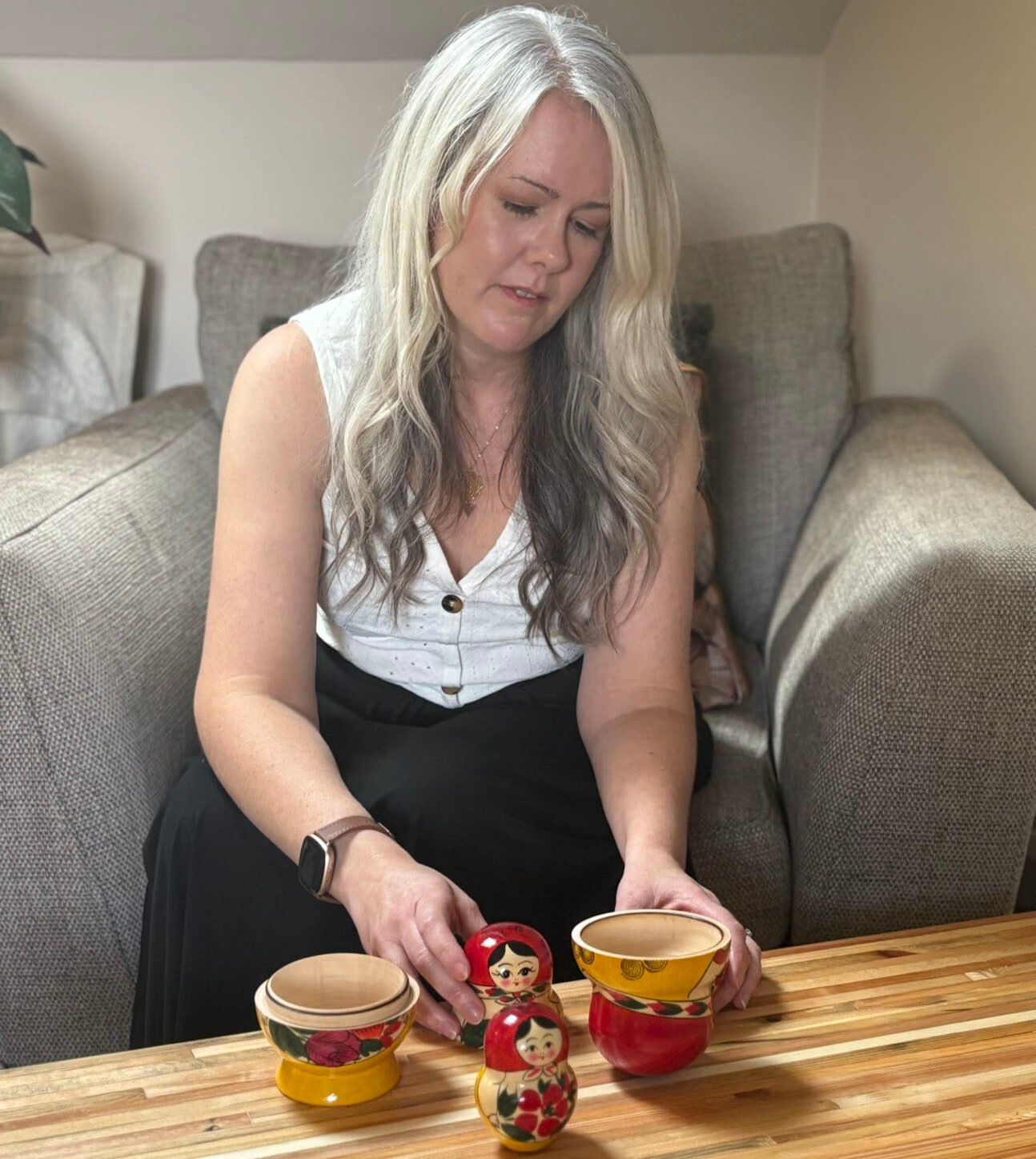
- Russian dolls: A gentle way to reach the younger you, the little one who sometimes still needs looking after.
You don’t need to be “creative,” and there’s never any pressure. It’s simply another door into the same room, and people often tell me they came to me because they couldn’t find this way of working anywhere else. We’ll only ever use what feels right for you.
What I can help with
I work with people through all sorts of things. Some of the areas I see most often:
- Anxiety, including social anxiety, health anxiety, generalised anxiety and panic attacks
- Depression and low mood
- Trauma and PTSD, including complex PTSD
- Neurodiversity, including ADHD and autism (including sensory processing)
- Relationship difficulties
- Fertility issues
- Postnatal depression/anxiety
- Low self-esteem and confidence
- Bereavement, and baby loss and miscarriage
- Burnout and work-related stress
- Domestic and emotional abuse
- Menopause
- LGBTQ+ counselling
- Self-harm and OCD
This isn’t a checklist you have to fit. You don’t need a diagnosis, and you don’t need to have it all figured out before you come. Honestly, most people don’t. If something’s affecting how you feel or getting in the way of daily life, that’s reason enough.
The practical bits
Where: in person at my therapy room in Beverley (HU17), or online via Google Meet and by phone or WhatsApp wherever you are.
Who: adults of all ages, from young adults through to older adults.
How long: each session is 50 minutes.
Cost: £60 a session. Your first 15-minute phone call is free.
Availability: flexible, including some evenings.
For organisations: I also offer counselling for employers and organisations, quoted separately.

My qualifications
You deserve to feel confident you’re in safe hands. I’m a relational psychotherapist and counsellor with integrative training. I’m an accredited member of the NCPS (National Counselling and Psychotherapy Society) and a member of the UKCP (UK Council for Psychotherapy), and I hold a Level 7 Diploma in Integrative and Transactional Analysis Psychotherapy, which is the equivalent of a Master’s degree.
Full list of qualifications
- Diploma in Integrative and Transactional Analysis Psychotherapy – Level 7 (equivalent to a Master’s degree)
- Diploma in Integrative and Transactional Analysis Psychotherapeutic Counselling – Level 6
- Transactional Analysis 101
- Counselling Skills – Level 3
- Counselling Skills – Level 2
- Mental Health First Aid Training
- Certificate in Supporting Parents Experiencing Depression
- Mindfulness Training
- Autism & Sensory Processing Awareness Training
- Domestic Abuse Awareness: Impact on Adults, Children & the Community Training
- Certificate in Understanding Children & Young People’s Mental Health
- Certificate in Mental Health Awareness
- Certificate in Equality & Diversity
- Creative Skills – Arts & Play in Client Work Training
- Extensive and varied CPD
Questions?
Starting therapy is a big decision, and it’s completely natural to have questions about how it works, my approach and what to expect. I’ve put together a proper FAQ section to help you feel more informed and a little more confident about taking this step.